How empty can this unit get before it loses money?
Every other Airbnb calculator tells you what a unit could earn. This one tells you how full it has to stay. Rent or mortgage, the nightly rate, the cleaner, and the 2026 Airbnb fee of about 15.5% that now lands on your cleaning fee too. Then the number the lease decision actually turns on: break even occupancy.
One unit
One unit is the easy part. Now judge the next two.
This page judges the unit in front of you. The Airbnb Profit and Deal Analyzer runs three units at once on the same chain, so you can see which lease to sign, which one to drop, and what the portfolio nets when unit two goes live three months after unit one.
- The same chain: nights, stays, cleaning in, platform fee out, cleaner, rent and fixed costs
- Break even occupancy and payback on furnishing per unit
- Compare tab, three units ranked by net profit
- What if table, net at 50, 60, 70, 80 and 90 percent occupancy
- Google Sheets and Excel, no macros, works on free plans
Instant download. Also on Gumroad.
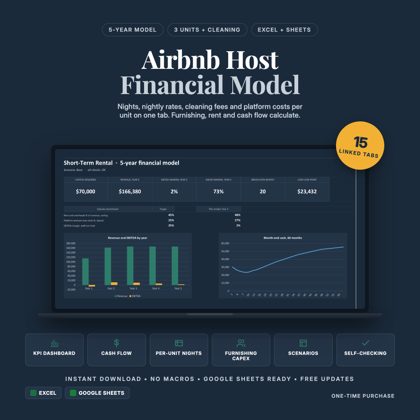
Get the Airbnb Deal AnalyzerBuilding a portfolio? The Airbnb Host Financial Model runs nights, rates and costs per unit month by month for five years, with staggered go live dates. $27.
How this calculator works
Every line is something you typed or a published rate, so you can argue with any of them. The chain matches the paid analyzer, so the two agree on the same unit. Market figures are 2026 US averages and are shown for context only, never as a forecast for your address.
| Line | Rate | Where it comes from |
|---|---|---|
| Nights booked | 30.4 nights a month times your occupancy. | 30.4 is the average month. Occupancy is the share of available nights that sell, the way AirDNA and Airbnb report it. |
| Turnovers | Nights divided by the average stay. | Each turnover costs a cleaner and a set of supplies, which is why a three night average is cheaper to run than a one night average at the same occupancy. |
| Airbnb service fee | 15.5% default, on nightly revenue and the cleaning fee together. | Airbnb is moving all hosts from the old split fee (about 3% host, 14% to 16.5% guest) to a single host fee of about 15.5%, deducted from the payout. It applies to the whole booking subtotal, cleaning fee included. Rates run roughly 14% to 16% by market. |
| Cleaning | Fee you charge the guest, minus the cleaner and supplies you pay per turnover. | US turnovers cost $50 to $100 for a studio or one bed, $75 to $150 for a two bed, $100 to $200 and up above that. Supplies add $5 to $20. |
| Management | 0% default, self managed. | Co-hosts charge 10% to 25% of gross, full service vacation rental firms 20% to 35%, half service 10% to 15% with cleaning left to you. |
| Utilities | $320 default. | Hosts report $200 to $400 a month for a small apartment and $400 to $800 for a whole house, power, water, gas and internet together. |
| Furnishing | About $4,500 a bedroom plus $3,000 of common areas. | A two bed lands near $12,000 budget, $18,000 mid range, $28,000 premium. Arbitrage hosts commonly start a first unit on $7,000 to $12,000 all in with a reserve. |
| Break even occupancy | Fixed costs divided by what one night contributes after fees and cleaning. | The number a lease decision turns on. Compare it with the occupancy your market actually runs, not the one you hope for. |
| 2026 US market | Occupancy about 57.4%, average daily rate about $259, both forecast slightly up on 2025. | AirDNA 2026 outlook. City averages run roughly 47% to 70%, so treat the national number as a sanity check only. |
Rates last reviewed September 2026. This is an estimate to plan with, not investment or tax advice. Income tax, licence fees that vary by city, and your own time are not in the monthly chain; the five year model carries them. Opening a business instead? Try the restaurant, coffee shop or ecommerce calculators.
Questions people ask
How do you calculate break even occupancy?
Fixed costs divided by what one night contributes. Fixed costs are rent or mortgage plus utilities, insurance and licences. A night contributes the rate after the platform fee, plus the share of the cleaning fee that night carries, minus the cleaner and supplies. The big number above does it for your unit and converts it into nights out of 30.
Does Airbnb really take 15.5% now?
For most hosts, yes. The old model split the fee: about 3% from the host and 14% to 16.5% from the guest. Airbnb is moving everyone onto a single host fee of about 15.5%, taken from your payout, with the guest seeing the price you set. Rates vary by market, roughly 14% to 16%. If you are still on the old split fee, type 3 into the fee box and watch what changes.
Does the fee apply to my cleaning fee?
Yes, and this is the line most calculators get wrong. The fee is charged on the whole booking subtotal, so a $120 cleaning fee leaves you about $101 while the cleaner still invoices in full. If your cleaning fee was set to match the cleaner exactly, you now lose money on every stay.
What occupancy should I plan for?
AirDNA puts the 2026 US average at 57.4%, with city averages between roughly 47% and 70%. Plan the deal 10 to 15 points below what you hope for, then look at the what if table. If the unit still clears its costs at that level, the lease is survivable.
How much will furnishing cost me?
About $4,500 a bedroom plus $3,000 for common areas, so a two bed lands near $12,000 at a budget level and $18,000 mid range. That money is gone before the first guest arrives, which is why the payback tile matters: at $900 a month of net profit, a $12,000 setup takes over a year to come back.
Is rental arbitrage still worth it?
It turns on the gap between the rent and what the unit earns after the platform fee, cleaning and the empty nights. The honest test is the break even number: a unit that needs 75% occupancy in a market that runs 57% is a liability with a lease attached. Under 55% and the deal has room to breathe.
Where the numbers come from
- Airbnb help centre, service fees, split fee and single fee structures
- AirDNA, 2026 US short term rental outlook, occupancy and ADR forecast
- AirROI, Airbnb occupancy rates by city, 2026
- Awning, short term rental cleaning fees and turnover costs, 2026
- Awning, cost to furnish an Airbnb, room by room, 2026
- TIDY, vacation rental management fees, 2026
- Guesty, how to start an Airbnb in the US, startup costs 2026
- Hospitable, Airbnb expenses hosts forget, utilities and supplies